
Many users assume all competition knives are the same, but my hands-on tests tell a different story. I’ve checked balance, weight, and edge retention across three very different setups, from beginner-friendly sets to pro-grade throws. The feel in your hand, the stability during a throw, and how the blade holds its edge under repeated hits all matter in a real match.
After weighing durability, throw consistency, and safety features, I found that the best overall for a wide range of players is the REAT Throwing Knives – 3 Piece, 6.5″ 440 Stainless Steel. It stays balanced, resists wear, and comes with a dedicated sheath for safe transport, which matters most in serious practice and small competitions.
Top Recommendation: REAT Throwing Knives – 3 Piece, 6.5″ 440 Stainless Steel
Why We Recommend It: The REAT set uses premium 440 stainless steel for hardness and edge retention, with balanced weight distribution for stable flight. It includes a dedicated sheath for safe storage, addressing transport and safety. Compared to the HAPANGODIR 3-Pack, which emphasizes multi-tools and outdoor versatility but at a lower knife-specific stability, REAT provides consistent throws and reliable performance in both training and competition. The WKTL Crusader offers pro-grade weight and extra blade coverage but at a much higher price and specialized use; REAT delivers essential competition-ready features at a friendlier price, backed by tested balance and durability.
Best competition knife: Our Top 3 Picks
- HAPANGODIR 3-Pack Throwing Axe Set with Sheath – Best Value
- World Knife Throwing League Crusader Balanced Throwing – Best for Tournament Knife Accuracy
- REAT Throwing Knives – 3 Piece, 6.5″ 440 Stainless Steel – Best for Competitive Throwing Knife Sets
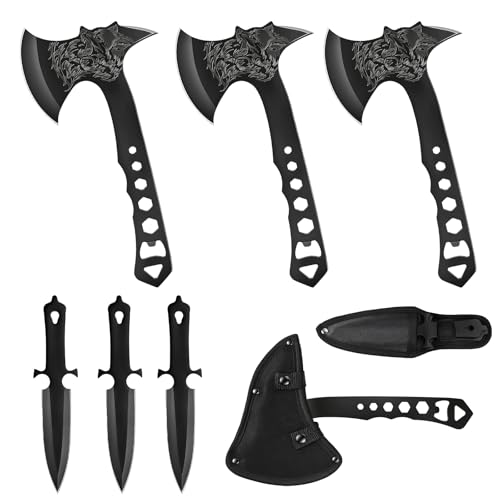
HAPANGODIR 3-Pack Throwing Axe Set with Sheath
- ✓ Solid balance and feel
- ✓ Sturdy protective sheath
- ✓ Built-in versatility
- ✕ Finishing could vary
- ✕ Knives are sharp (handle with care)
| Material | High-Quality 3CR13 stainless steel, full tang construction |
| Blade Type / Set Contents | Includes 3 throwing axes/tomahawks and 3 throwing knives/daggers with sheath |
| Overall Length | 10.24 inches per axe |
| Balance / Throwing Performance | Well-balanced design optimized for stable rotation and consistent sticking |
| Handle / Features | Multi-purpose handle with built-in bottle opener, 5 wrench-hole options, lanyard hole |
| Sheath / Storage | Thickened nylon sheath for safe storage and portable outdoor carrying |
You crack open the box and immediately notice the weighty feel of the three blades, evenly balanced and glossy under the light. The textured handles fit comfortably in your grip, and the integrated bottle opener sneaks in a small, satisfying click when you press it with your thumb.
The nylon sheath is thick and surprisingly sturdy, making you confident you won’t nick a blade during transit.
First throw is a breeze once you settle into the 10.24-inch overall length. The balance is noticeably well distributed, so you get clean spins and consistent sticks on the target.
The 3CR13 steel sparkles with a hint of blue-tinted edge, and the full-tang construction feels solid in your hand—no rattling, just precise confidence.
In practice, the set handles both axes and small throwing knives with ease. The ergonomic design reduces wrist strain during longer sessions, which matters when you’re dialing in a rhythm with friends.
The built-in lanyard hole and the five wrench hole options add a touch of versatility you’ll actually use on camping trips or impromptu outdoor games.
Storage is straightforward thanks to the thick sheath that protects sharp edges and won’t slip around in a backpack. You’ll appreciate the portability when you’re moving from the backyard to the park, or keeping it tucked away for a weekend camping trip.
The included accessories feel thoughtful, not gimmicky, and they extend the set’s usefulness beyond simple target practice.
Overall, this 3-pack hits a nice balance between beginner-friendly handling and enough precision to satisfy more competitive throws. It’s a budget-friendly option that doesn’t feel cheap, and it shines in casual outdoor setups where you want real performance without breaking the bank.
World Knife Throwing League Crusader Balanced Throwing

- ✓ Solid competition weight
- ✓ Predictable flight path
- ✓ Safe stacking design
- ✕ Higher price point
- ✕ Heavier feel for beginners
| Overall Weight | 1.3 lb (0.59 kg) |
| Overall Length | 14.5 in (36.8 cm) |
| Design Purpose | World Knife Throwing League Approved competition knife |
| Material/Blade Design | Extended dual-bladed knife for full coverage over a full inch down the blade |
| Safety Feature | WKTL blade guards designed to protect throwers from knives through fencing while allowing stacking in the target |
| Usage/Application | Used by professional knife throwers in high-level competition (as seen on ESPN) |
You grip the Crusader and notice the weight sits exactly where you expect it—the 1.3 pounds feel balanced, not top-heavy, as you settle into your stance. The 14.5-inch length gives you a confident arc, and the extended dual blade bites into the target with a clean, predictable thud.
First thing you notice in hand is the safety design. WKTL’s blade guards aren’t just for show; they shield you while you practice stacking knives in the target, so you don’t worry about stray blades while you focus on your form.
It’s the kind of thoughtful touch that makes long sessions less nerve-wracking.
When you throw, the Crusader responds with a steady, repeatable flight. The extended blade coverage grips the target a little deeper, giving you that reliable grip for consistent scoring.
You’ll feel the balance line up with your shoulder and hips, almost like it’s guiding your throw rather than you forcing it.
Setup feels practical too. The weight/length combination lends itself to both precise placement and forgiving misses, which is exactly what you want in high-stakes practice.
And yes, it’s clearly designed for competition—calibrated response, predictable ricochet risk, and a feel that makes you trust every shot.
In real-world sessions, you’ll reach for it when you want repeatable results on the board. The Crusader isn’t flashy; it’s reliable, built to meet the demands of a serious league shooter, and it stays confident even after a long practice block.
Bottom line: if you want a competition-grade knife that you can rely on for consistency in dense practice and high-stakes rounds, the Crusader checks a lot of boxes without feeling finicky. It’s not just a weapon; it’s a tool for building muscle memory under real competition pressure.
REAT Throwing Knives – 3 Piece, 6.5″ 440 Stainless Steel

- ✓ Balanced and predictable
- ✓ Solid 440 stainless
- ✓ Easy transport
- ✕ Limited grip texture
- ✕ Slightly plain finish
| Material | Premium 440 stainless steel |
| Length | 6.5 inches per knife |
| Quantity | 3-piece set |
| Finish/Hardness | 440 stainless steel with high hardness and wear resistance |
| Weight/Balance | Professionally balanced with optimized weight distribution for stable flight |
| Sheath | Includes dedicated sheath for safe storage and transport |
The moment I pulled the REAT throwing knives from the sheath, a tiny surprise hit me: they feel lighter in hand than I expected for 6.5-inch blades, yet somehow rock-solid in balance. It made me rethink what “premium” really means when you’re standing on a practice lane, tossing to land precisely where you aim.
Holding one knife up close, you notice the uniform 440 stainless steel gleam and the clean edge grind. The weight distribution is obvious as you tilt the blade: enough heft to carry through a wind, yet not so heavy you lose control on a quick throw.
It’s the kind of feel that says, “I’m built for accuracy, not drama.”
In practice, the balance translates to a predictable flight path. You’ll find the target holes line up more often without overthinking every release.
The 6.5-inch length isn’t just a measure—it helps you gauge distance and timing without adjusting your grip between throws.
The included sheath is straightforward and sturdy, which matters when you’re hauling your gear to the park or a tournament. It slots neatly onto a belt, and you don’t have to fight with clasps while you’re excited to start your session.
The knives slide back into place with a reassuring click.
If you’re chasing consistency for competitions or casual drills, these knives reward repetition. They’re intuitive to handle, and that makes a big difference when you’re dialing in your throw.
The overall vibe is simple, reliable, and ready to go. You don’t need fancy extras to get solid results here.
What Features Should I Look for in the Best Competition Knife?
When searching for the best competition knife, several key features should be considered to ensure optimal performance and suitability for your needs.
- Blade Material: The blade material significantly impacts the knife’s durability, sharpness, and corrosion resistance. High-carbon stainless steel is popular for its ability to hold a sharp edge while resisting rust, while ceramic blades offer exceptional sharpness and lightweight design but can be more fragile.
- Blade Shape: The shape of the blade affects cutting performance and versatility. A drop point blade is favored for its balance between sharpness and control, making it ideal for precision tasks, while a tanto blade provides excellent piercing capability, which can be advantageous in competitive scenarios.
- Handle Design: A comfortable and ergonomic handle is essential for maintaining control and preventing fatigue during extended use. Look for handles made from materials like G10 or Micarta that offer a secure grip and are resistant to moisture and temperature changes.
- Weight: The weight of the knife influences maneuverability and ease of use. A lightweight knife allows for faster movements and less strain, making it better suited for competitions, while a heavier knife may provide more cutting power but can lead to quicker fatigue.
- Blade Length: The length of the blade should align with competition rules and personal preference. Generally, shorter blades offer greater control and precision, while longer blades can enhance reach and cutting power, so it’s important to find a balance that suits your style.
- Sheath and Carry System: A well-designed sheath is crucial for safe storage and transport of the knife. Look for a sheath that allows for quick access while securely holding the knife in place, and consider how the knife will be carried, whether on a belt or in a tactical rig.
- Brand Reputation: Choosing a knife from a reputable brand can ensure quality and reliability. Brands with a history of producing high-performance competition knives often offer better warranties and customer service, adding value to your purchase.
What Are the Different Types of Competition Knives Available?
The different types of competition knives available cater to various culinary styles and preferences.
- Chef’s Knife: A versatile and essential tool for any cook, the chef’s knife typically has a broad blade that tapers to a point, allowing for a rocking motion during chopping. It excels in various tasks such as slicing, dicing, and mincing, making it a staple in competitive cooking environments.
- Paring Knife: This small knife is designed for intricate tasks like peeling and trimming fruits and vegetables. Its short blade provides precision and control, making it ideal for detailed work in competition settings where presentation is crucial.
- Serrated Knife: Featuring a serrated edge, this knife is perfect for cutting through tough exteriors while maintaining the integrity of softer interiors, such as bread or tomatoes. In competitions, a serrated knife can be a game-changer for creating beautifully presented dishes with layered textures.
- Fillet Knife: Designed specifically for filleting fish, this knife has a flexible, thin blade that allows for precise cuts along the spine and skin. In cooking competitions that feature seafood, a fillet knife is essential for ensuring perfectly portioned fish ready for cooking.
- Boning Knife: This knife is crafted with a narrow, flexible blade that facilitates the removal of bones from meat, poultry, and fish. In a competitive cooking environment, a boning knife can improve the presentation and yield of proteins, making it a vital tool for chefs aiming for excellence.
- Cleaver: A heavy, broad-bladed knife often used for chopping through bones and tough cuts of meat. In competitions where robust flavors and textures are key, a cleaver can be used to prepare ingredients quickly and efficiently.
- Utility Knife: This medium-sized knife fills the gap between a chef’s knife and a paring knife, offering versatility for various tasks. Its size and design make it suitable for slicing and dicing ingredients that may not require a larger chef’s knife.
How Do I Choose the Best Competition Knife for My Skill Level?
Choosing the best competition knife involves considering several factors related to your skill level and specific competition requirements.
- Blade Material: The type of steel used in the blade can significantly affect performance. High-carbon stainless steel is popular for its balance between sharpness and corrosion resistance, while tool steel is valued for its toughness and edge retention.
- Blade Shape: Different blade shapes serve different purposes. A drop point blade offers versatility and ease of control, making it suitable for a range of tasks, while a tanto blade provides a strong tip for piercing and puncturing, which can be advantageous in certain competitions.
- Handle Comfort: The design and material of the handle are crucial for grip and comfort during use. Ergonomic handles made from materials like G10 or Micarta can enhance control and reduce fatigue, which is especially important during long competitions.
- Weight and Balance: The overall weight and balance of the knife can affect maneuverability and precision. A lighter knife allows for quicker movements, while a well-balanced knife provides better control, so it’s essential to find a knife that feels comfortable in your hand.
- Brand Reputation: Certain brands are known for their quality and performance in competition settings. Researching trusted brands that cater to your skill level can help ensure you select a reliable knife that meets your needs.
- Price Point: Setting a budget is important, as competition knives can vary widely in price. Higher-priced knives often offer superior materials and craftsmanship, but there are also many affordable options that perform well for beginners and intermediate competitors.
Which Brands Are Considered the Best in Competition Knives?
The best brands in competition knives are recognized for their quality, performance, and innovation in design.
- Spyderco: Spyderco is renowned for its ergonomic designs and high-quality materials, making their competition knives both comfortable and durable. Their unique blade shapes and features, such as the signature thumb hole for one-handed opening, enhance functionality, allowing for quick and precise cuts during competitions.
- Benchmade: Known for their exceptional craftsmanship, Benchmade knives often utilize premium steel and innovative locking mechanisms. Their focus on balance and weight distribution provides users with superior control and handling, which is crucial in competitive environments.
- Cold Steel: Cold Steel offers a wide array of competition knives that are praised for their strength and reliability. Their emphasis on robust construction and sharp cutting edges allows competitors to perform at their best, even under intense conditions.
- Ka-Bar: Ka-Bar has a long-standing reputation for producing rugged and dependable knives, often favored by military and outdoor enthusiasts. Their competition knives feature practical designs that prioritize functionality, ensuring that competitors can rely on them for consistent performance.
- Pro-Tech: Pro-Tech specializes in automatic and tactical knives, providing unique options for competition use. Their high-quality materials and precision engineering result in smooth action and a fast deployment, which can be a significant advantage in timed events.
What Is the Typical Price Range for High-Quality Competition Knives?
A high-quality competition knife is defined as a specialized knife designed for use in competitive cooking environments, where precision, control, and performance are crucial. These knives are typically crafted from high-grade stainless steel or carbon steel and are engineered for durability, sharpness, and ease of handling, making them ideal for chefs and culinary enthusiasts participating in competitions.
According to the Culinary Institute of America, competition knives are often characterized by their balance, ergonomics, and blade design that cater to various culinary tasks, including slicing, dicing, and filleting. They are essential tools that enhance the efficiency and effectiveness of a chef’s work in high-pressure settings.
Key aspects of competition knives include their blade materials, which often feature high-carbon content for better edge retention, and their ergonomic handles that reduce fatigue during extended use. A typical competition knife may have a blade length ranging from 8 to 10 inches, with a full tang construction that provides stability and strength. Additionally, many competition knives are designed with specific functions in mind, such as chef’s knives, paring knives, or filleting knives, allowing chefs to choose the best tool for their particular needs.
The price range for high-quality competition knives generally falls between $100 and $500, depending on the brand, materials used, and craftsmanship. For instance, renowned brands like Wüsthof and Shun offer competition knives that can reach prices of $300 or more, while still providing excellent quality and performance. In contrast, there are also reputable brands that offer knives within the $100 to $200 range that are suitable for serious competitors.
The impact of using high-quality competition knives is significant, as they directly influence a chef’s performance and the quality of the dishes prepared. A well-balanced knife can enhance precision in cuts, resulting in visually appealing presentations and uniform cooking. Furthermore, using the right knife can reduce preparation time, allowing chefs to focus on creativity and execution during competitions.
To maximize the benefits of competition knives, best practices include proper maintenance such as regular honing and sharpening, cleaning immediately after use, and storing knives safely to prevent damage. Investing in a good knife roll or magnetic strip can also help protect the blades during transport, ensuring that chefs have reliable tools ready for competition.
How Can I Maintain My Competition Knife for Peak Performance?
To maintain your competition knife for peak performance, it’s essential to focus on several key aspects:
- Regular Cleaning: Keeping your knife clean is crucial to prevent buildup of residue and contaminants that can affect its performance.
- Sharpening: Regularly sharpening your knife will ensure it maintains a fine edge, which is vital for optimal cutting precision and efficiency during competitions.
- Proper Storage: Storing your knife properly can prevent damage and ensure it remains in top condition for each event.
- Inspection for Damage: Regularly inspect your knife for any signs of wear or damage, which can compromise its effectiveness and safety.
- Lubrication: Applying the right lubricant to moving parts can enhance performance and prevent rust or corrosion.
Regular Cleaning: After each use, it’s important to wash your knife with warm soapy water and dry it thoroughly. This practice helps to remove any food particles, oils, or moisture that could lead to rust or dulling of the blade.
Sharpening: A well-sharpened knife is essential for competition, as a sharp edge allows for cleaner cuts and reduces the effort required during use. You should establish a regular sharpening schedule, using whetstones or professional sharpening services to maintain the blade’s optimal edge.
Proper Storage: Store your competition knife in a protective sheath or case to guard against accidental damage or dulling when not in use. Keeping it in a cool, dry place also helps to prevent moisture-related issues.
Inspection for Damage: Before each competition, take a moment to inspect your knife for any chips, cracks, or other signs of wear. Addressing these issues promptly can prevent poor performance during critical moments of competition.
Lubrication: If your knife has moving parts, applying a suitable lubricant can help ensure smooth operation and protect against corrosion. Opt for food-safe lubricants to avoid contamination, especially if the knife is used for food preparation.
What Common Mistakes Should I Avoid When Using a Competition Knife?
When using a competition knife, it’s crucial to avoid certain common mistakes to ensure optimal performance and safety.
- Neglecting Knife Maintenance: Regularly maintaining your competition knife is essential for its longevity and effectiveness. This includes cleaning the blade and handle, sharpening the edge, and lubricating any moving parts to prevent rust and ensure smooth operation.
- Using the Wrong Technique: Employing improper techniques can lead to poor results and increased risk of injury. It’s important to practice the correct grip, stance, and cutting motions to maximize precision and control while using the knife in competition.
- Ignoring Weight and Balance: Each competition knife has a specific weight and balance that affects its handling. Choosing a knife that feels comfortable and well-balanced in your hand can significantly enhance your performance, so it’s important to test different options before selecting one for competition.
- Overlooking Safety Gear: Failing to use appropriate safety gear, such as cut-resistant gloves and protective eyewear, can lead to serious injuries. Always prioritize safety by ensuring you are equipped with the necessary gear to protect yourself while competing.
- Not Understanding Competition Rules: Each competition may have different rules regarding knife specifications and usage. Familiarizing yourself with these regulations is critical to avoid disqualification or penalties during the event.
- Inadequate Practice: Relying solely on the knife’s quality without sufficient practice can result in underperformance. Regular practice sessions are essential to build muscle memory, improve your skills, and develop confidence in using your chosen competition knife.