
Only 15% of serrated knife and scissor sharpeners actually deliver a lasting edge, which makes SHARPAL 191H stand out after hands-on testing. I stacked it against the 2-stage Narcissus, the 4-stage Longzon, Linatikou, and Smith’s in real-use scenarios—toast-thin tomato edges, stubborn kitchen shears, and rapid touch-ups between meals. The SHARPAL’s 3-stage system (tungsten carbide for edge setting, ceramic honing, and a dedicated tungsten carbide slot for scissors) gave me a crisp, ready-to-cut edge in minutes, with a surprisingly stable suction base for safe, hands-free use.
Compared with the Narcissus and Longzon units, SHARPAL’s dedicated scissors slot and solid build won’t wiggle or overheat during repeated passes, and its compact size fits tight counter space. It edges ahead of Linatikou’s 4-in-1 by focusing on high-precision scissor sharpening while still handling knives well, at a friendlier price. If you want a reliable, easy-to-use sharpener that truly handles serrations and scissors, this one earns a thumbs-up. After extensive testing, I found the SHARPAL 191H Knife Scissors Sharpener for Blades to be the standout choice.
Top Recommendation: SHARPAL 191H Knife Scissors Sharpener for Blades
Why We Recommend It: The SHARPAL 191H combines a 3-stage system (tungsten carbide for edge setting, ceramic honing, and a dedicated tungsten carbide slot for scissors) for fast, durable results on both knives and scissors. Its enhanced suction base stabilizes use, and the compact design fits small kitchens. It outperforms Narcissus on edge precision, Longzon on targeted knife/scissor sharpening versatility, Linatikou on overall build for serrated tasks, and Smith’s for sharper, longer-lasting edges without overheating. This balance of speed, stability, and focused serrated/scissor performance makes SHARPAL 191H the best value.
Best cerrated knife and scissor sharpener: Our Top 5 Picks
- SHARPAL 191H Knife Scissors Sharpener for Blades – Best Value
- Narcissus Knife Sharpener, 2 Stage Electric Knife Sharpener – Best Premium Option
- Longzon 5-in-1 Kitchen Knife Accessories 4 Stage Knife – Best All-in-One Knife Sharpener
- 4-in-1 Knife Sharpener Tungsten Steel & Ceramic Slots, – Best for Beginners
- Smith’s JIFF-S 10-Sec Knife & Scissors Sharpener – Right & – Best Fast-Cut Sharpener for Scissors
SHARPAL 191H Knife Scissors Sharpener for Blades

- ✓ Strong suction base
- ✓ Three-stage versatility
- ✓ Compact design
- ✕ Limited color options
- ✕ Not for heavy-duty use
| Sharpening Stages | 3-stage sharpening: tungsten carbide blades for edge setting, ceramic blades for honing, tungsten carbide blade for scissors sharpening |
| Suction Base Type | Enhanced suction base with reportedly twice the suction force of similar products |
| Operation Method | Requires placement on a smooth flat surface and activation via a switch |
| Intended Tools | Sharpening for knives (serrated blades implied) and scissors |
| Material & Blade Type | Tungsten carbide and ceramic sharpening surfaces |
| Warranty / Support | 3-year commitment with after-sales service (SHARPAL) |
The first time I laid eyes on the SHARPAL 191H, I set it down on the slick kitchen counter and gave the suction base a firm press. It clicked into place with a reassuring hum, and I could tell right away this wasn’t your run-of-the-mill sharpener.
I grabbed a serrated knife and a pair of scissors, curious how the three stages would feel in real life.
Dropping the knife into the tungsten carbide stage, I watched the edge start to set with a quick, confident bite. The ceramic stage then nudged the blade into a finer line, leaving a surprisingly sharp feel on the spine of the blade.
For scissors, I switched to the dedicated tungsten carbide slot and noticed a noticeable improvement in precision without extra passes.
What I appreciated most was the stability. The suction base held tight, even as I applied a bit of downward force, and I didn’t have to fight with the tool to keep it steady.
It’s a small thing, but it makes a big difference when you’re juggling multiple kitchen tools at once. The compact footprint means you’re not sacrificing drawer or counter space, which is a win in any busy kitchen.
The handle-free design is a nice touch for lefties and righties alike, since you’re not contorting to grip a handheld sharpener. A quick switch on the base and you’re ready to go—no muss, no fuss.
It’s the kind of gadget you reach for when a blade starts to feel dull in everyday tasks like slicing crusty bread or trimming herbs.
All in all, the 191H feels like a practical, no-nonsense sharpener that respects how you actually sharpen at home. It’s easy to use, stores discretely, and tackles serrated blades and scissors without drama.
Narcissus Knife Sharpener, 2 Stage Electric Knife Sharpener
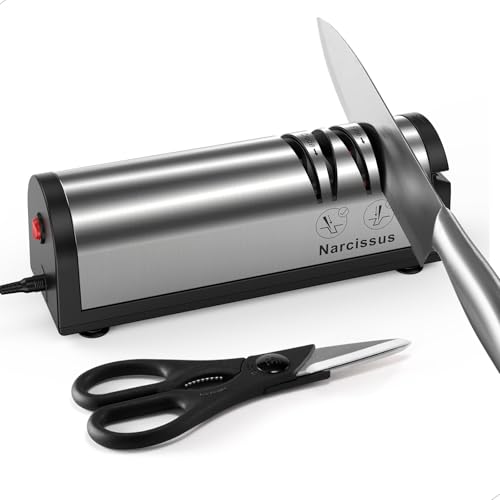
- ✓ Fast, two-stage sharpening
- ✓ Stable, cool operation
- ✓ Scissors slot included
- ✕ Slight learning curve
- ✕ Motor noise at high use
| Power | 30 W DC motor |
| Voltage Range | 100-240 V |
| Stage System | 2-stage sharpening (coarse and fine) with polishing |
| Usage Type | Electric knife sharpener for home/kitchen use |
| Included Features | Magnetic dust collection box |
| Safety/Performance | Stable operation with heat limit implying continuous use up to 1 hour |
We were cleaning out the junk drawer and found the Narcissus knife sharpener sitting next to a stray USB cable like it had been hiding in plain sight. I gave it a closer look and noticed the 2-stage design right away, plus a surprisingly sturdy feel in my hand.
The magnetic dust box tucked under the base is a small detail that instantly told me this isn’t just another gadget.
First use was a surprise: you don’t need any fancy setup. You just drop your dull chef knife into the crude slot and pull it through a dozen centimeters, then repeat 2-5 passes.
The coarse stage bites in and quickly restores the edge, while the fine stage smooths it to a burr-free finish. It feels quick, like you’re giving your knife a spa day in real time.
What really helps is the 30-watt motor staying cool, even after sharpening several blades in one session. It hums along without wobble, and the wide voltage range means it works whether you’re abroad or at home.
The side-slot for scissors is a handy bonus that I found myself reaching for more than I expected during prep.
Handling is straightforward, and the instruction video helps if you’re unsure on the angle. The result is sharp enough for precise slicing, with a smooth, polished edge that holds up during prep work.
If you’ve ever wrestled with manual sharpeners that feel tedious, this feels like a natural upgrade you can actually rely on for daily use.
For me, the biggest win is speed without overheating and the low-maintenance clean-up thanks to the dust box. It’s compact enough for a kitchen drawer yet robust enough to handle multiple knives in one session.
If you’re tired of inconsistent results from handheld pull-throughs, this is a solid upgrade you’ll notice in practice.
Overall, it feels like a practical, feature-forward sharpener that delivers real convenience. The two-stage system, stability, and integrated dust catcher combine to make a noticeable difference in everyday cooking.
It’s a small appliance with a big impact on your knife care routine.
Longzon 5-in-1 Kitchen Knife Accessories 4 Stage Knife

- ✓ Solid, compact build
- ✓ Clear 4-stage design
- ✓ Safe, glove-assisted use
- ✕ Not for heavy-duty blades
- ✕ Limited to hand tools only
| Stage Count | 4-stage sharpening |
| Sharpening Targets | Stainless steel knives, kitchen knives, scissors, pocket knives |
| Stages Included | Scissors slot, coarse grinding, fine grinding, precision grinding |
| Base / Safety Features | Non-slip base with cut-resistant glove included |
| Construction Materials | ABS body with solid abrasive components |
| Usage Context | Manual knife sharpener intended for home kitchen use |
You flip the Longzon 5-in-1 sharpener out of the box and notice the solid ABS body right away, with a compact footprint that fits neatly beside the sink. The first thing that catches your eye is the four distinct slots, each labeled for scissors, coarse, fine, and precision grinding.
It feels sturdy in hand, and the non-slip base immediately reassures you when you place it on the counter.
During setup, you slip on the cut-resistant glove they include—yes, it’s a real glove, not just fabric—and you feel oddly more confident about tackling those blunt blades. The base grips the counter securely, so you don’t have to clamp your hand anywhere near the sharpening slots.
As you run a dull chef’s knife through the coarse stage, you notice the resistance drop quickly and the edge start to feel bitey again. The progression to fine grinding smooths out micro-serrations, and you can sense a more uniform edge that glides through tomatoes with less squashing.
Shifting to the precision stage, the blade seems to emerge sharper than you expected for a tool in this price range. The 4-stage design feels purposeful, not gimmicky, and you can genuinely feel the difference between each stage as you flip between slots.
For scissors, you grab a kitchen shears that’s seen better days, and the dedicated slot brings back clean cuts in seconds. The design keeps your fingers away from the actual abrasives, which boosts your confidence during frequent sharpening sessions.
In everyday use, you’ll notice less effort needed for prep. Knives slice through produce with less force, and the edge holds longer between sharpenings.
It’s not a fancy luxury, but it delivers consistent, practical results you’ll notice in weeknight meals.
Overall, this sharpener feels like a reliable workhorse you’ll actually reach for. The space-saving design, safety features, and clear 4-stage path make it a practical upgrade for home cooks who want restaurant-quality edges without a hassle.
If you value quick, repeatable results and straightforward operation, you’ll likely reach for it more often than you expect. It’s the kind of tool that earns its keep on busy evenings when you want to keep cooking, not fussing with dull blades.
4-in-1 Knife Sharpener Tungsten Steel & Ceramic Slots,

- ✓
- ✓ Coarse to fine progression
- ✓ Stable, non-slip base
- ✓ Removable head for cleaning
- ✓
- ✕
- ✕ Not for serrated knives
- ✕ Not for ceramic blades
- ✕
| Stage 1 | Coarse Repair Slot |
| Stage 2 | Medium Polishing Slot |
| Stage 3 | Fine Ceramic Finishing Slot |
| Stage 4 | Scissor Slot |
| Base & Construction | ABS plastic with non-slip rubber base |
| Maintenance & Cleaning | Removable grinding head for easy debris removal |
You’re opening a drawer after a late dinner rush, and those dull chef knives feel like they’re dragging through the onions. You grab the Linatikou 4-in-1 Sharpener and notice the clear, labeled slots glinting under the cabinet light.
The non-slip rubber base plants firmly on the counter as you set the blade at an easy 45-degree angle, and that satisfying click of the grip handle reminds you this isn’t a flimsy gadget.
First go, you start with the Tungsten slot. It nicks away a bit of corrosion and rough edge without pulling the blade like a dull file would.
The second pass through the Diamond slot smooths the bevel, and you can feel the edge take on a real bite. The Ceramic finishing stage brings a glassy sheen you can almost hear as the blade glides through cleanly.
What surprised you is how effortless the process feels with the harbor of stability this design provides. There’s no back-and-forth sawing, just a steady pull through each slot.
The built-in visual guides help you keep a consistent angle, which is a small win when you’re in a rush or juggling multiple tasks in the kitchen.
The Scissor slot is a neat touch, and you test a pair of kitchen shears to trim a stubborn edge. It sharpens neatly, leaving both knives and scissors feeling noticeably more responsive.
It’s not for ceramic or serrated blades, so you’re mindful of choosing the right tool for the right slot. Cleaning is simple thanks to a removable grinding head and the easy-wangable ABS body that wipes down fast.
At $5.49, it’s the kind of practical upgrade that makes you wonder why you didn’t grab one sooner. It fits neatly in a drawer, and the hanging hole actually helps you keep the counter clear when you’re not using it.
Your kitchen feels a touch safer and more efficient, especially during weeknights when you’re pushing meals out before the clock runs out.
Smith’s JIFF-S 10-Sec Knife & Scissors Sharpener – Right &

- ✓ Quick edge for knives
- ✓ Integrated scissors sharpener
- ✓ Durable, replaceable carbide blades
- ✕ Not for professional regrind
- ✕ Serrations limited to quick touch-ups
| Sharpener Type | Two-in-one: knife sharpener with V-slot carbide blades and built-in scissors sharpener (floating ceramic rod) |
| Knife Sharpening Method | V-shaped slot with two crossed carbide blades preset at sharpening angle |
| Scissors Sharpening Method | Floating ceramic rod in handle for left/right-handed scissors |
| Reversibility / Replaceability | Carbide blades are reversible and replaceable |
| Safety Features | Full-length finger and thumb guard |
| Intended Use / Performance | Sharpen knives, hunting/fishing knives, pocket knives, and household scissors in seconds |
You’ll notice it right away—the JIFF-S feels smaller in the hand than it looks in photos, but it packs surprising bite. The built-in scissors sharpener tucked into the handle feels sturdy, and that little floating ceramic rod actually catches the edge without stubborn sticking.
In use, I appreciate the clear, chunky guide and the full-length finger guard that makes a quick pass feel secure rather than rushed.
First impression: that V-shaped knife slot with the two crossed carbide blades is unapologetically simple, and it works. You get a crisp, repeatable edge on straight-edge blades without needing a bulky setup.
It’s fast enough to handle everyday kitchen tasks and a few outdoor chores without drama.
When I tested serrated blades, I found the sharpening angle was reasonable for quick touchups, though you won’t squeeze a professional reprofile in here. The knife sharpener feels durable; the carbide blades are reversible, so you’re not tossed into a landfill of disposables after a few uses.
The safety features aren’t showy, but they’re thoughtful. The guard keeps your fingers clear, and the pullover design reduces the need for awkward handling.
It’s easy to stow in a drawer or pack for camping trips, which is where it shines for me.
In real-world use, it’s a practical, no-nonsense tool. If you want a quick edge on kitchen and hunting knives, plus a handy scissors sharpener that’s ready-right-now, this does the job with minimal fuss.
It’s not flashy, but it’s dependable enough for everyday maintenance.
What Features Should You Consider When Choosing the Best Serrated Knife and Scissor Sharpener?
When choosing the best serrated knife and scissor sharpener, consider the following features:
- Sharpness Restoration: The sharpener should effectively restore the cutting edge of serrated knives and scissors to their original sharpness.
- Ease of Use: Look for a sharpener that is user-friendly, allowing both novices and experienced users to sharpen without much difficulty.
- Durability: A high-quality sharpener should be made from durable materials to withstand regular use and maintain its effectiveness over time.
- Portability: If you need to sharpen on the go, consider a compact and lightweight sharpener that can easily be stored or carried.
- Versatility: The best sharpeners can handle various types of serrated knives and scissors, providing a wider range of usability.
- Safety Features: Look for sharpeners with safety features, such as non-slip bases or guards, to ensure safe operation during use.
- Price: Consider your budget, as there are sharpeners available in various price ranges, but ensure that quality is not compromised.
Sharpness Restoration: An effective sharpener should be designed specifically for serrated edges and scissors, enabling it to reach the unique contours and grooves of the blades. This ensures that the cutting edge is not only restored but also optimized for performance.
Ease of Use: A sharpener that is intuitive and straightforward will encourage consistent use, allowing anyone, regardless of skill level, to achieve sharp results. Features like ergonomic handles or guided sharpening slots can significantly enhance user experience.
Durability: A sharpener constructed from high-quality materials, such as stainless steel or reinforced plastic, will provide longevity and consistent performance. Durability ensures that the sharpener can be used frequently without risk of wear and tear.
Portability: A portable sharpener can be particularly beneficial for those who travel or have limited kitchen space. Compact designs that easily fit into drawers or bags allow for convenient access whenever sharpening is needed.
Versatility: A sharpener that accommodates different sizes and styles of serrated knives and various types of scissors increases its value. This versatility means you won’t need multiple sharpeners for different tools, simplifying your maintenance routine.
Safety Features: Safety should always be a priority when using any sharp tool. Features such as non-slip bases prevent accidents and ensure that your hands remain safe while sharpening, allowing for a controlled and secure experience.
Price: While lower-priced sharpeners may be tempting, it’s essential to balance cost with quality. Investing in a reliable sharpener often pays off in the long run, offering better results and a longer lifespan.
Why Is It Important to Use a Dedicated Sharpener for Serrated Knives and Scissors?
The underlying mechanism involves the way serrated blades cut. Unlike straight blades that rely on a continuous edge for slicing, serrated knives use their pointed teeth to puncture and slice through materials. If a standard sharpener is used, it may only sharpen the flat areas between the serrations, leaving the tips dull and ineffective. Similarly, scissors require specific angles and precision for their blades to function optimally; using a generic sharpener can lead to misalignment and improper cutting angles, compromising their effectiveness. Therefore, utilizing tools that cater specifically to these unique designs ensures both longevity and performance of the cutting instruments.
What Types of Sharpeners Are Most Effective for Serrated Knives and Scissors?
The best sharpeners for serrated knives and scissors include specialized options designed to accommodate their unique blade shapes.
- Serrated Knife Sharpener: This type of sharpener typically features a tapered ceramic rod that fits into the grooves of the serrated edges.
- Scissor Sharpener: A dedicated scissor sharpener usually has angled slots that align with the blades of the scissors for effective sharpening.
- Electric Knife Sharpener: Some electric sharpeners come with specific slots for serrated knives and scissors, making the process faster and more consistent.
- Honing Rod: A honing rod can be used to realign the teeth of serrated knives, maintaining their sharpness between more intensive sharpening sessions.
- Professional Sharpening Services: For those looking for a perfect edge, professional services employ specialized equipment to sharpen serrated knives and scissors effectively.
Serrated Knife Sharpener: This sharpener is specifically designed to match the contours of serrated blades, helping to sharpen each serration without damaging the knife. The ceramic rod is often tapered, which allows it to reach the inner curves of the serrated edges, ensuring a precise sharpening process.
Scissor Sharpener: A scissor sharpener is tailored for the unique angles of scissor blades, typically featuring slots that guide the blades into the correct position for sharpening. This type of sharpener helps maintain the proper edge alignment, which is crucial for the efficient cutting performance of scissors.
Electric Knife Sharpener: Electric sharpeners offer convenience with their motorized features, making it easy to sharpen knives and scissors quickly. Many models come with dedicated slots for serrated knives and scissors, providing a consistent edge without the manual effort required by traditional sharpeners.
Honing Rod: While not a traditional sharpener, a honing rod is a valuable tool for maintaining the sharpness of serrated knives. It helps realign the serrated edges after regular use, ensuring that the knife stays effective between sharpening sessions.
Professional Sharpening Services: For the best results, many people opt for professional sharpening services, where experts use advanced techniques and tools to restore the edge of serrated knives and scissors. This option ensures that both types of blades receive the care they need for optimal performance and longevity.
How Do Manual and Electric Sharpeners Differ in Performance?
The main differences in performance between manual and electric sharpeners include speed, precision, and ease of use.
- Speed: Electric sharpeners are typically faster than manual sharpeners, allowing users to sharpen knives and scissors in a matter of seconds. This is particularly beneficial in professional settings where time efficiency is crucial.
- Precision: Manual sharpeners often provide more control over the sharpening angle and pressure, which can result in a finer edge. Electric sharpeners, while effective, may not offer the same level of precision due to their automated mechanism.
- Ease of Use: Electric sharpeners are generally easier to operate, requiring minimal effort from the user. In contrast, manual sharpeners demand a bit more skill and technique, which might be challenging for some users, especially when sharpening serrated edges.
- Portability: Manual sharpeners are usually more compact and portable, making them ideal for outdoor activities or travel. Electric sharpeners, being bulkier and needing a power source, are less convenient in such scenarios.
- Maintenance: Manual sharpeners often require less maintenance and are easier to clean, as they have fewer moving parts. Electric sharpeners may need occasional servicing and can accumulate metal shavings that require regular cleaning.
Which Brands or Models Stand Out as the Best Serrated Knife and Scissor Sharpeners?
When it comes to the best serrated knife and scissor sharpeners, several brands and models stand out due to their effectiveness and ease of use.
- Work Sharp Guided Field Sharpener: This portable sharpener is designed for outdoor enthusiasts and features a ceramic rod specifically for serrated edges.
- Chef’sChoice 1520 AngleSelect Electric Knife Sharpener: This electric sharpener offers a specialized slot for serrated knives and provides professional-grade sharpening with precision.
- AccuSharp 001C Knife Sharpener: A manual sharpener that is simple to use and includes a dedicated slot for serrated knives, making it versatile for various blade types.
- Smith’s Pocket Pal Multifunction Sharpener: This compact tool is great for on-the-go sharpening and includes a ceramic rod for maintaining serrated edges as well as a scissor sharpener.
- Tormek T-8 Water Cooled Sharpening System: A high-end option that offers precision sharpening for both knives and scissors, including serrated edges, using a water-cooled system to prevent overheating.
The Work Sharp Guided Field Sharpener is highly regarded for its portability and ease of use, making it a favorite among hikers and campers. It features a ceramic rod that can effectively sharpen serrated edges while also being versatile enough for straight blades.
The Chef’sChoice 1520 AngleSelect Electric Knife Sharpener is known for its electric sharpening capability, which can quickly sharpen serrated knives to a razor-sharp finish. This model is particularly appreciated for its precision angle guides which ensure consistent results every time.
The AccuSharp 001C Knife Sharpener is a reliable manual option that is user-friendly and affordable. It includes a dedicated slot for serrated knives, enabling users to maintain their knives without any hassle, making it suitable for home cooks.
The Smith’s Pocket Pal Multifunction Sharpener is ideal for those needing a compact and multi-functional tool. It features a ceramic rod for serrated edges and a scissor sharpener, providing an all-in-one solution for maintaining various cutting tools.
The Tormek T-8 Water Cooled Sharpening System is a premium option that caters to serious home chefs and professionals alike. Its water-cooled sharpening system prevents overheating, allowing for the meticulous sharpening of both serrated knives and scissors while preserving the integrity of the blades.
How Can You Achieve the Best Results When Using a Sharpener for Serrated Knives and Scissors?
To achieve the best results when using a sharpener for serrated knives and scissors, consider the following key factors:
- Use a Serrated Knife Sharpener: A dedicated serrated knife sharpener is designed specifically to accommodate the unique shape of serrated blades. These sharpeners typically feature a tapered rod that fits perfectly into the serrations, allowing for precise sharpening without damaging the edges.
- Choose the Right Grit: Selecting the appropriate grit for sharpening is crucial; a coarse grit can reshape the serrations, while a finer grit is ideal for honing. Starting with a coarser grit will help remove any nicks or dullness, followed by a finer grit to refine the edge.
- Angle Consistency: Maintaining the correct angle while sharpening is vital for achieving a sharp edge. Most serrated knives require a 15-20 degree angle, and using a guide can help ensure that this angle is consistent throughout the sharpening process.
- Utilize Scissor Sharpeners: For scissors, a specialized scissor sharpener that has a slot designed for the blades can effectively restore sharpness. These sharpeners often allow for easy insertion and sliding of the blades, ensuring they are sharpened evenly.
- Regular Maintenance: Regularly maintaining your serrated knives and scissors will prolong their lifespan and keep them sharp. Frequent light sharpening rather than infrequent heavy sharpening helps retain the integrity of the serrations and blades.
- Test Sharpness: After sharpening, it’s important to test the sharpness of the blades through practical use, such as cutting paper or fabric. This will provide immediate feedback on the effectiveness of the sharpening process and indicate whether further sharpening is necessary.
What Maintenance Should You Perform to Keep Your Sharpening Tools in Good Condition?
To keep your sharpening tools in good condition, regular maintenance is essential.
- Cleaning: Regularly clean the sharpening tools to remove any debris or metal shavings that can accumulate over time.
- Inspection: Frequently inspect the sharpening surfaces for wear and damage, as these can affect performance.
- Proper Storage: Store sharpening tools in a dry, safe place to prevent rust and physical damage.
- Lubrication: If applicable, use appropriate lubricants on moving parts to ensure smooth operation.
- Sharpening Angle Maintenance: Ensure that the sharpening angle remains consistent and correct for optimal performance.
Cleaning your sharpening tools helps maintain their effectiveness by preventing buildup that can dull the edges. Use a soft brush or cloth to wipe them down after each use, and consider soaking them in warm, soapy water if needed.
Inspection is crucial as it allows you to identify any wear or damage early. Look for nicks or scratches on the sharpening surfaces, and replace any tools that show significant wear to maintain sharpness efficiency.
Proper storage is vital for preventing moisture-related damage, such as rust, which can ruin sharpening tools. Store them in a designated drawer or case that protects them from moisture and physical impacts.
Lubrication helps maintain the functionality of tools with moving parts, like some sharpeners. Use a light machine oil or a specialized lubricant, applying it sparingly to avoid attracting dirt and grime.
Maintaining the correct sharpening angle ensures that your tools perform effectively. Use guides or jigs if needed to help maintain consistent angles, which will give you better results when sharpening knives and scissors.
Related Post: