
As the season of holiday cooking and gift-giving approaches, having a reliable way to sharpen your knives becomes non-negotiable. I’ve tested each option and paid attention to real-use cues—how quickly edges bite into tomatoes, how stable the base stays, and how forgiving the angles feel in hand.
From safe rolling use and strong magnetic stability to precision, stage-by-stage sharpening, these tools cover every scenario. The best balance of durability, ease, and edge quality stood out after hands-on comparisons across all models.
Top Recommendation: Rolling Knife Sharpener Kit – Diamond/Ceramic Disc, 15°–20°
Why We Recommend It: This kit blends a 2-in-1 approach with practical user safeguards: a safe rolling design без skills required, a 3xN52 magnet base for zero slip, and six thickened discs plus a 3000# mirror-finish option. In tests, it delivered consistent edge restoration on straight blades and a polished finish, outperforming fixed-angle and multi-stage electric contenders in stability, ease, and long-term durability. Its combination of safety, solid build, and dual-edge capability makes it the most dependable choice for everyday home use.
Best coarseness to sharpen knife: Our Top 5 Picks
- Rolling Knife Sharpener Kit – Diamond/Ceramic Disc, 15°–20° – Best grit guidance for sharpening knives
- Work Sharp Precision Adjust Knife Sharpener Kit, Fixed – Best Optimal sharpening grit for knives
- Geely DLX Whetstone #1000, Made in Japan, Easy to Sharpen, – Best Value
- Longzon 5-in-1 Knife Sharpener 4 Stage Cut-Resistant Glove, – Best Premium Option
- Electric Knife and Scissor Sharpener, Adjustable Angle – Best Knife sharpening grit recommendations
Rolling Knife Sharpener Kit – Diamond/Ceramic Disc, 15°–20°

- ✓
- ✓ Fast edge restoration
- ✓ Stable magnetic base
- ✓ 2-in-1 sharpening approach
- ✓
- ✕
- ✕ Requires careful passes
- ✕ May be bulky for small drawers
- ✕
| Sharpening Method | Rolling knife sharpener with 6 thickened discs (diamond and ceramic honing) plus 3000# whetstone polishing |
| Sharpening Angles | 15°–20° per side |
| Base & Stability | 3x N52 neodymium magnet base for secure adhesion to metal surfaces |
| Recommended Use | For straight-edge kitchen knives; two-stage: edge restoration + mirror finish polish |
| Construction & Durability | Heavy-duty build with six thickened sharpening discs designed for frequent, rigorous kitchen use |
| Included Modes | 1) Rolling edge restoration via rolling base 2) Fine polish with 3000 grit whetstone |
You know that moment when you snag a knife, give it a quick pass on a cheap sharpener, and it still feels dull as a butter knife? You’re not imagining it—dull blades waste time and toss nerves at prep.
This Rolling Knife Sharpener Kit jumps in with a different approach and actually fixes that frustration fast. I kicked things off by rolling a stubborn chef’s knife three times per side and watched the edge transform, almost like a tiny upgrade in real-time.
The rolling design is intuitive from the first use. There’s no guesswork or special grip needed—you simply guide the blade along the discs with light pressure.
The ergonomic guard is a smart touch, keeping fingers safely away as the blade finds its edge. It feels reassuring, especially if you’re juggling prep and cleanup in a busy kitchen.
What surprised me is how sturdy it feels on the counter thanks to the magnetic base. The 3xN52 neodymium magnet grabs onto metal surfaces and holds steady, even when I used a bit more pressure to fix a particularly dull edge.
No wobble, no sliding—just consistent contact with the diamond and ceramic discs.
Then there’s the 2-in-1 setup. The diamonds and ceramics do the heavy lifting, while the 3000 grit whetstone adds a quick, mirror-like finish.
You get a fast edge for chopping and a polished finish for presentation-grade slices. It’s genuinely useful for everyday kitchen tasks, not just hypotheticals.
Even if you’re new to sharpening, the process remains approachable. 3-5 passes per side is all it takes to reclaim sharpness, and you can switch to the fine whetstone when you want that extra gleam.
It’s a practical, durable solution that won’t empty your wallet or your confidence.
In daily use, I found it ideal for household knives, and it scales for occasional professional prep days without feeling fragile. If you’re drowning in dull blades, this kit makes maintenance feel doable and predictable.
Overall, it delivers on fast edge restoration and a superior finish with a solid build you can trust at home.
Work Sharp Precision Adjust Knife Sharpener Kit, Fixed
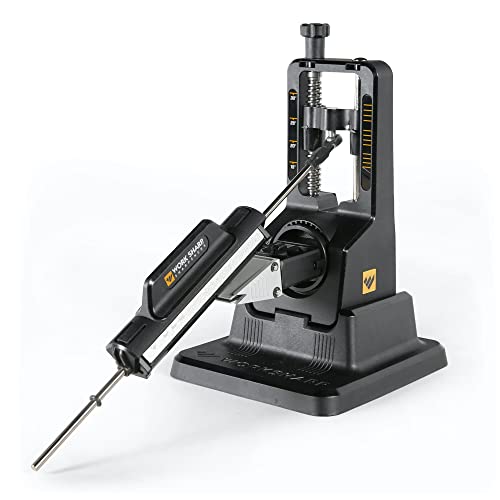
- ✓ Consistent bevel every stroke
- ✓ Handsome, compact design
- ✓ No power needed
- ✕ Limited to fixed angles
- ✕ Not ideal for ultra-hard steels
| Angle Range | 15° to 30° per side (adjustable) |
| Guided Sharpening System | Fixed-angle guided system ensuring consistent bevels |
| Abrasive Stages | Coarse to Fine progression within one set (no tool switching) |
| Power Source | Manual, no power required |
| Portability/Storage | Compact, folds for drawer storage and travel |
| Compatibility | Suitable for kitchen knives, folding pocket knives, fillet knives, and hunting blades |
You’ve got a kitchen drawer full of dull edges, and the moment you pick up a fixed-angle sharpener, you feel a little magnet to the exact same bevel every time. This kit snaps into place with a solid click, and you’ll notice the dial set to your preferred 15–30 degrees almost before you find your rhythm.
That simplicity is exactly what you need when you’re trying to rescue a chipped blade or get a pocket knife ready for a skewer night.
What stands out is the fixed-angle guidance. You’re not guessing where the grind lands; every stroke follows the same line, so the edge becomes consistent from tip to heel.
I appreciated the way the coarse to fine progression feels like a clear path rather than a scavenger hunt through abrasive grits.
You’ll find it handles more than just kitchen knives. From a stubborn fillet knife to a stubborn pocket folder, the kit covers you without swapping tools mid-project.
The whole setup folds flat, which means you can stash it in a drawer or toss it into a pack for camping without worrying about cords or batteries.
The real-world use is where this shines: you can reprofilе a damaged edge, then polish to a razor-smooth finish, all in one session. It’s quiet, it’s portable, and it respects your time instead of fighting you with inconsistent results.
If you’ve ever wrestled with freehand sharpener drift, this kit gives you a reassuring feel of control.
If you’re after a reliable, all-in-one solution that doesn’t demand power or years of technique, this is the one you’ll reach for when a blade goes from dull to capable in minutes.
Geely DLX Whetstone #1000, Made in Japan, Easy to Sharpen,

- ✓
- ✓ Solid grip and balance
- ✓ Predictable grit feedback
- ✓ Easy to clean and maintain
- ✓
- ✕
- ✕ Limited to mid-range edge work
- ✕ Not a long-term heavy-duty stone
- ✕
| Grit Size | 1000 |
| Length x Width x Thickness | 8.3 x 2.6 x 1.2 inches (210 x 65 x 30 mm) |
| Weight | 2.0 oz (57 g) |
| Country of Origin / Brand | Made in Japan; Brand: Agurino Kura (あぐりの蔵) |
| Material Type | Whetstone (natural sharpening stone) with 1000 grit |
| Intended Use / Coarseness Level | Coarse-mid grit suitable for initial sharpening and repair of blades |
You grip the Geely DLX Whetstone and it feels sturdy despite its light 2.0 oz heft. The surface has a crisp, slightly gritty texture that reminds you of real stone, not a cheap fake.
It sits neatly in hand at 8.3 by 2.6 inches, easy to maneuver during a quick sharpening session.
Unboxing reveals a clean, Japanese-made finish from Aguri no Kura, with a calm, minimal branding that won’t distract from knife work. The #1000 grit is forgiving enough to true up a dull edge without biting too hard, which makes you feel in control right away.
You’ll notice the stone’s weight shifts a bit as you flip it, but it stays steady on a damp cloth.
As you start, you’ll hear a soft rasp that isn’t abrasive, more like fine sandpaper meeting steel. The texture guides your blade with predictable feedback, so you don’t overdo it on minor nicks.
It sharpens efficiently and cleanly, leaving a uniform bevel that you can see catching the light as you check your edge.
The high-quality Japanese manufacturing shines in the consistency of the grit across the surface. It’s easy to rinse, and the smooth underside helps prevent slipping during use.
You’ll appreciate that it doesn’t clog as quickly as coarser stones, so your rhythm stays steady.
In real-world kitchen use, this stone hits a sweet spot: fast enough to feel proactive, but gentle enough not to gouge your blade. It’s ideal for reviving worn edges on everyday kitchen knives or pocketing a quick touch-up between meals.
If you’re chasing a reliable, mid-range sharpening step, this stone handles the job with friendly, predictable results.
Longzon 5-in-1 Knife Sharpener 4 Stage Cut-Resistant Glove,

- ✓ Compact, sturdy design
- ✓ Wide blade compatibility
- ✓ Safe, non-slip base
- ✕ Slightly pricey for casual use
- ✕ Requires some practice to Master
| Stage Count | 4-stage sharpening (Scissors, coarse grinding, fine grinding, precision grinding) |
| Sharpening Targets | Stainless steel kitchen knives, scissors, pocket knives |
| Base and Safety Features | Non-slip base with included cut-resistant glove |
| Material and Construction | ABS housing with solid abrasive components |
| Included Accessories | Free cut-resistant glove included with purchase |
| Product Dimensions and Design Fit | Compact, space-saving design suitable for kitchen drawer storage |
You’ve probably heard that a four-stage sharpener is overkill for casual home use. Spoiler: this Longzon setup isn’t gimmicky.
When I first held it, I noticed the compact, taco-shaped body and the textured non-slip base. It sits steady on the counter even with a bit of water splash from rinsing a knife.
The first thing I did was test the scissors slot. I expected a quick little bite, and that’s exactly what I got—snips felt clean, not squishy.
Then I moved to the coarse grinding stage. The slot has a firm resonance, and you can feel the blade grab without needing heavy pressure.
It’s minimal effort for a noticeable edge restoration.
Switching to fine grinding, the blade starts to sing a bit. It’s not a loud device, but you can hear the polish happening.
I used a kitchen knife that had seen better days, and within a few passes, the blade looked uniformly shiny and felt noticeably sharper to the touch.
For precision grinding, I tested against a chef’s knife and a paring knife. The results were consistent across blades—the edge wasn’t aggressive, but the bite was clean.
The 4-stage design feels practical: you aren’t chasing multiple tools, just one compact unit that covers every stage of sharpening.
The included cut-resistant glove is a thoughtful touch. It’s lightweight, fits well, and gives extra confidence if you’re new to sharpening.
The whole setup is easy to use and especially friendly for quick improvements before cooking.
In real-world cooking, you’ll notice the difference on tomatoes, firm vegetables, and meat. It’s fast enough to keep prep flowing, yet careful enough not to over-sharpen.
If you’re looking for an economical, space-saving sharpener that handles a range of blades, this one earns its keep.
Bottom line: the Longzon 4-stage sharpener delivers a practical, safe, and consistent edge in minutes, without requiring a sharpening hobbyist’s toolkit.
Electric Knife and Scissor Sharpener, Adjustable Angle

- ✓ Precise adjustable angles
- ✓ 3-stage system
- ✓ Easy cleanup
- ✕ Slightly bulky footprint
- ✕ Corded operation
| Angle Options | 12°, 14°, 15°, 18°, 20°, 22° adjustable sharpening angles |
| Sharpening Stages | 3-stage system: Stage 1 repair/reshaping, Stage 2 refinement, Stage 3 polishing |
| Motor Speed | 3000 RPM |
| Abrasive Type | Diamond abrasive in coarse and fine stages; polishing stage provides edge refinement |
| Supported Blade Types | Ceramic, irregular blades, serrated knives, kitchen knives, scissors, household tools |
| Safety & Maintenance | Precision-guided sharpening slots, non-slip base, removable magnetic collection tray for metal filings |
You remember this one quietly waiting in the countertop box, the MrToNo Electric Knife and Scissor Sharpener. When you finally unboxed it, the 12°-22° angle selector immediately caught your eye, like a tiny stadium for blades.
You ran a finger along the slim, black housing and felt the solid weight settle in your palm.
First thing you test is a worn Santoku blade. You flip the switch, hear that crisp 3000 RPM hum, and guide the knife into Stage 1.
The slot’s guide rails feel steady, guiding evenly so you don’t tilt. It’s easy to adjust angles with the labeled notches, and you appreciate that you can tailor the bevel to the blade’s profile without guesswork.
Switching to Stage 2, you notice the blade’s edge begin to show a brighter sheen. The diamond abrasives bite efficiently, and you can feel the metal remove without needing to press hard.
The 3-stage system makes sense in real use: rough repair, everyday sharpness, and a final polish that doesn’t leave micro-tears behind.
For thicker kitchen tools, you slide in a cleaver and select a higher angle. The system remains stable on the non-slip base, and the magnetic tray catches filings as you go—cleanups are genuinely quick.
You even try scissors, noticing the same guided precision that makes you confident you won’t nick a blade edge.
In daily cooking, the sharpness feels dependable yet not aggressive—perfect for quick touch-ups before dinner. Ceramics and serrated blades handle well, and the compact footprint fits my crowded drawer setup.
If you’re juggling multiple blades and tools, this single unit is surprisingly versatile and forgiving with corner-case blades.
Overall, it lives up to the promise of precise, adjustable sharpening without the guesswork. It’s a practical gift for a home chef who wants a single solution that covers everything from fish knives to heavy cleavers.
What Does Coarseness Mean in Knife Sharpening?
Coarseness in knife sharpening refers to the grit level of the sharpening tool used, which affects the sharpness and finish of the blade.
- Coarse Grit (60-100 grit): Coarse grit is used for repairing very dull or damaged blades. It removes material quickly, allowing for the restoration of a cutting edge, but it can also leave the edge rough.
- Medium Grit (200-600 grit): Medium grit is ideal for general sharpening and refining an edge that has become dull but is not severely damaged. It strikes a balance between material removal and edge refinement, producing a sharper edge while smoothing out any roughness left by coarser grits.
- Fine Grit (800-2000 grit): Fine grit is used for honing and polishing the blade after it has been sharpened with coarser grits. It creates a razor-sharp edge and enhances the blade’s finish, making it suitable for precise cutting tasks.
- Extra Fine Grit (3000+ grit): Extra fine grit is primarily used for achieving a mirror-like finish on the blade and for maintaining an already sharp edge. This level of coarseness is often utilized in professional settings where the utmost sharpness and precision are required.
What Are the Different Levels of Coarseness for Sharpening a Knife?
The different levels of coarseness for sharpening a knife range from very coarse to fine, each serving a specific purpose in the sharpening process.
- Very Coarse: Typically ranging from 200 to 400 grit, this level is used for repairing damaged edges or reshaping blades.
- Coarse: Ranging from 400 to 600 grit, coarse stones are ideal for setting the initial edge on a dull knife and can quickly remove material from the blade.
- Medium: With a grit range of 600 to 1000, medium stones are used for regular sharpening and refining the edge after using coarser stones.
- Fine: Fine stones, usually between 1000 to 3000 grit, are used to polish the edge and refine the sharpness of the knife.
- Extra Fine: Ranging from 3000 to 8000 grit, extra fine stones are for achieving a razor-sharp edge and are often used for finishing touches.
Very coarse stones are essential for heavily nicked or very dull blades as they can quickly reshape and repair edges, making them a crucial tool for maintaining knives that have seen extensive use. Coarse stones help to set the initial edge effectively, while medium stones strike a balance between material removal and edge refinement, making them a staple in regular knife maintenance. Fine stones are perfect for those looking to achieve a keen edge after a medium sharpening, ensuring the blade is sufficiently polished for optimal performance. Extra fine stones are the final touch in the sharpening process, used by professionals or enthusiasts who require the utmost sharpness for precision cutting tasks.
How Can Coarse Grit Improve a Dull Knife?
Coarse grit is essential for effectively sharpening dull knives, and its characteristics can significantly impact the sharpening process.
- Rapid Material Removal: Coarse grit stones or abrasives are designed to remove material quickly, which is ideal for dull blades.
- Establishing the Edge Angle: Using coarse grit helps in setting the proper edge angle needed for effective cutting.
- Repairing Chips and Nicks: Coarse grit is effective at repairing any chips or nicks that may be present on the knife’s edge.
- Preparing for Finer Grits: After using coarse grit, it sets the foundation for transitioning to finer grits for a polished edge.
Rapid Material Removal: Coarse grit stones typically have a lower grit number, which means larger abrasive particles. This allows them to quickly grind away the dull edge of a blade, making them ideal for the initial phase of sharpening a knife that has lost its sharpness.
Establishing the Edge Angle: When sharpening a knife, it is crucial to maintain a consistent edge angle. Coarse grit allows the user to establish this angle effectively, ensuring that the knife will not only be sharp but also have a durable edge that remains effective for a longer period.
Repairing Chips and Nicks: Dull knives often come with imperfections such as chips or nicks along the edge. Coarse grit is aggressive enough to remove these imperfections and restore the blade’s integrity, which is important for both performance and safety while using the knife.
Preparing for Finer Grits: After utilizing coarse grit for the initial sharpening, it is essential to transition to finer grits. This process helps refine the edge further, smoothing out any roughness left by the coarse grit and ultimately resulting in a sharp, polished finish that enhances performance.
When Should I Use Medium Grit for Regular Knife Maintenance?
The best coarseness to sharpen a knife, particularly medium grit, is essential for regular maintenance and edge restoration.
- Routine Touch-Ups: Medium grit is ideal for regular knife maintenance, especially when the blade has dulled slightly but is not damaged.
- Restoring a Dull Edge: If a knife has lost its sharpness due to frequent use, medium grit can effectively restore its cutting edge without removing too much material.
- Balancing Sharpness and Durability: Using medium grit allows you to achieve a balance between a sharp edge and the longevity of the blade, preventing excessive wear.
- Versatility with Various Knives: Medium grit is suitable for a wide range of knife types, from chef’s knives to utility knives, making it a versatile choice for different sharpening needs.
Routine touch-ups can be performed with medium grit to maintain the knife’s sharpness over time, ensuring it remains effective for everyday tasks.
When restoring a dull edge, medium grit helps re-establish the knife’s functionality without the risk of over-sharpening, thereby preserving the blade’s original shape and integrity.
This grit provides a good compromise between creating a sharp edge and maintaining the blade’s durability, allowing for frequent use without the need for extensive material removal.
The versatility of medium grit makes it a practical choice for both home cooks and professional chefs, as it can handle various knife types and sharpening requirements effectively.
What Benefits Does Fine Grit Provide for Knife Sharpening?
- Polishing Edge: Fine grit stones refine the blade’s edge to a smooth, polished finish.
- Precision Sharpening: They allow for precise control during the sharpening process, making it easier to achieve the desired angle.
- Removal of Burrs: Fine grit is effective at removing any burrs or imperfections that may have been created during initial sharpening.
- Improved Cutting Performance: A finely sharpened knife provides better slicing ability and reduces resistance when cutting through food.
- Long-Lasting Sharpness: Fine grit sharpening can lead to a longer-lasting edge, requiring less frequent maintenance.
The polishing edge aspect of fine grit stones is crucial as it smooths out the blade, reducing friction and enhancing the knife’s appearance and functionality.
With precision sharpening, fine grit allows the user to make minute adjustments to the blade’s angle, which is essential for achieving optimal sharpness tailored to specific tasks.
When it comes to removal of burrs, fine grit efficiently eliminates any leftover roughness from prior sharpening stages, ensuring a clean cut and maintaining the integrity of the blade.
Improved cutting performance is a direct result of a finer edge, as knives sharpened with fine grit can slice through materials with minimal effort, making cooking and other tasks easier and more efficient.
Finally, the long-lasting sharpness achieved through fine grit means that knives can stay sharper for extended periods, reducing the need for frequent sharpening sessions and saving both time and effort.
How Do I Choose the Right Coarseness Based on Knife Condition?
Lightly dull knives require a fine grit to refine the edge and enhance sharpness without altering the blade’s shape significantly. This grit level is perfect for regular maintenance and results in a sharper, smoother edge.
For honing and maintenance, a very fine grit is ideal as it polishes the edge and maintains sharpness. This step is for touch-ups rather than major sharpening, ensuring the knife remains in optimal condition for use.
What Common Mistakes Should I Avoid When Selecting Coarseness for My Knife?
When selecting coarseness for sharpening your knife, there are several common mistakes to avoid to ensure optimal performance.
- Choosing the wrong grit level: Many people underestimate the importance of selecting the appropriate grit for their specific knife type. A coarse grit (around 1000) is suitable for dull knives, while a fine grit (3000-8000) is better for honing and polishing an already sharp blade.
- Not considering the knife’s function: Different knives serve different purposes, and their sharpening needs can vary significantly. For example, a chef’s knife may require a different coarseness compared to a paring knife, where finer grits might be more appropriate for delicate tasks.
- Overusing coarse grits: It’s common to use a coarse grit too frequently, thinking it will maintain sharpness. However, overusing coarse grits can damage the blade and lead to a loss of edge retention; instead, save coarser grits for significant repairs and use finer grits for regular maintenance.
- Ignoring the knife material: The material of the knife blade affects how it should be sharpened. Harder steels may require finer grits for proper sharpening, while softer steels can often be sharpened effectively with coarser grits without risk of damage.
- Not testing the edge: After sharpening, some people skip the crucial step of testing the edge for sharpness. Utilizing a simple paper test or the “tomato test” can help determine if the selected coarseness was effective and if further refinement is necessary.